National Accuracy Clearinghouse
Leading research and design for a new interstate data matching system
Challenge
The 2018 Farm Bill mandated that the USDA's Food and Nutrition Service (FNS) build a National Accuracy Clearinghouse (NAC), a data matching system that would prevent duplicate SNAP enrollment across state lines. At application, this system would be used to check whether an applicant was currently receiving benefits elsewhere and facilitate the resolution. 18F was brought in to design and build the initial version of the system and facilitate an assisted acquisition to set FNS up for full rollout across all states and ongoing maintenance.
This system would interact with a deeply complex ecosystem: 50 states with wildly different technology stacks, workers with established workflows, and applicants in vulnerable situations who could be wrongly denied benefits if the system got it wrong. All states would eventually be required to adopt the system, but voluntary early adoption required buy-in, and buy-in required trust and ease of use.
Client
Food and Nutrition Service, US Department of Agriculture
Contribution
Senior design researcher and designer for the18F team working with FNS. I led foundational and participatory user research, facilitated alignment among stakeholders, designed the initial UI, coordinated pilot state recruitment, and managed the vendor transition for design.
Impact
The NAC launched with pilot states and is now in national rollout, with a federal mandate requiring all states to implement by October 2027. The research, design foundations, and partner relationships built during this phase shaped a system that had to work for workers with vastly different tools, in states with vastly different contexts — while protecting some of the most vulnerable applicants in the process.
Research
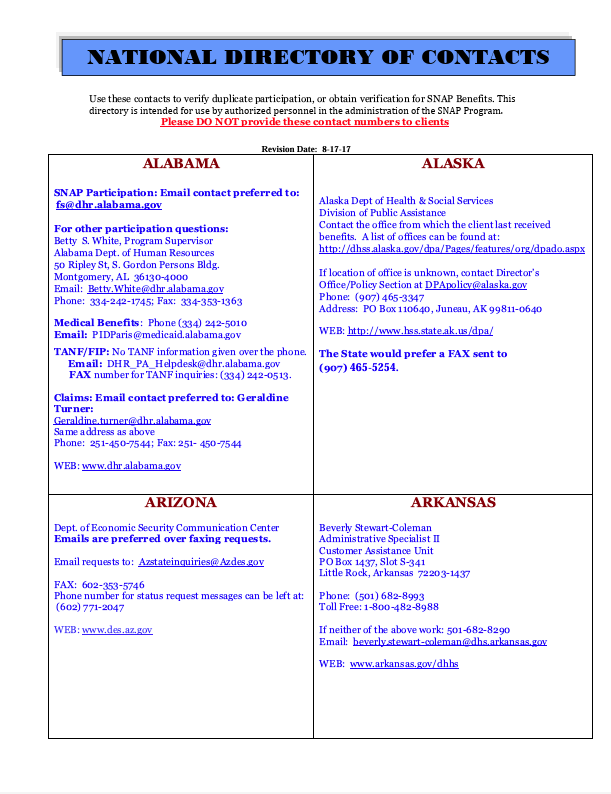
The National Directory of Contacts was the tool that SNAP workers used to get in touch with other states in cases of potential duplicate participation.
I introduced human-centered design to FNS staff and proposed a user research plan for foundational research to inform the design and implementation of the NAC. While I felt that research with SNAP recipients who had the experience of applying for benefits in multiple states would be informative, our research began with SNAP workers who process applications and would be the primary first-level users of the new system. Through the NAC Steering Committee — a cross-regional group FNS had already organized — I recruited SNAP workers across roughly ten states for one-hour semi-structured interviews and contextual observation sessions.
Key findings shaped the entire product direction:
Workers were already checking for duplicate enrollment ad hoc, relying on an irregularly updated PDF to contact other states — a painful, inconsistent process, that a new system could improve upon, thereby solving a pain point and incentivizing adoption
The NAC mapped naturally onto existing data checks workers already ran (like the Death Master File), giving us a mental model to design toward
We also surfaced critical edge cases involving domestic violence survivors, children in split-custody situations, and identity theft — all requiring careful handling to avoid wrongful denials
Research was continuous throughout the project, facilitated by the NAC Steering Committee. Another key research activity was a series of participatory design workshops with SNAP workers, in which we walked them through the proposed new system and invited them to co-design the way it would fit into their current workflows, bring up questions, and offer feedback.
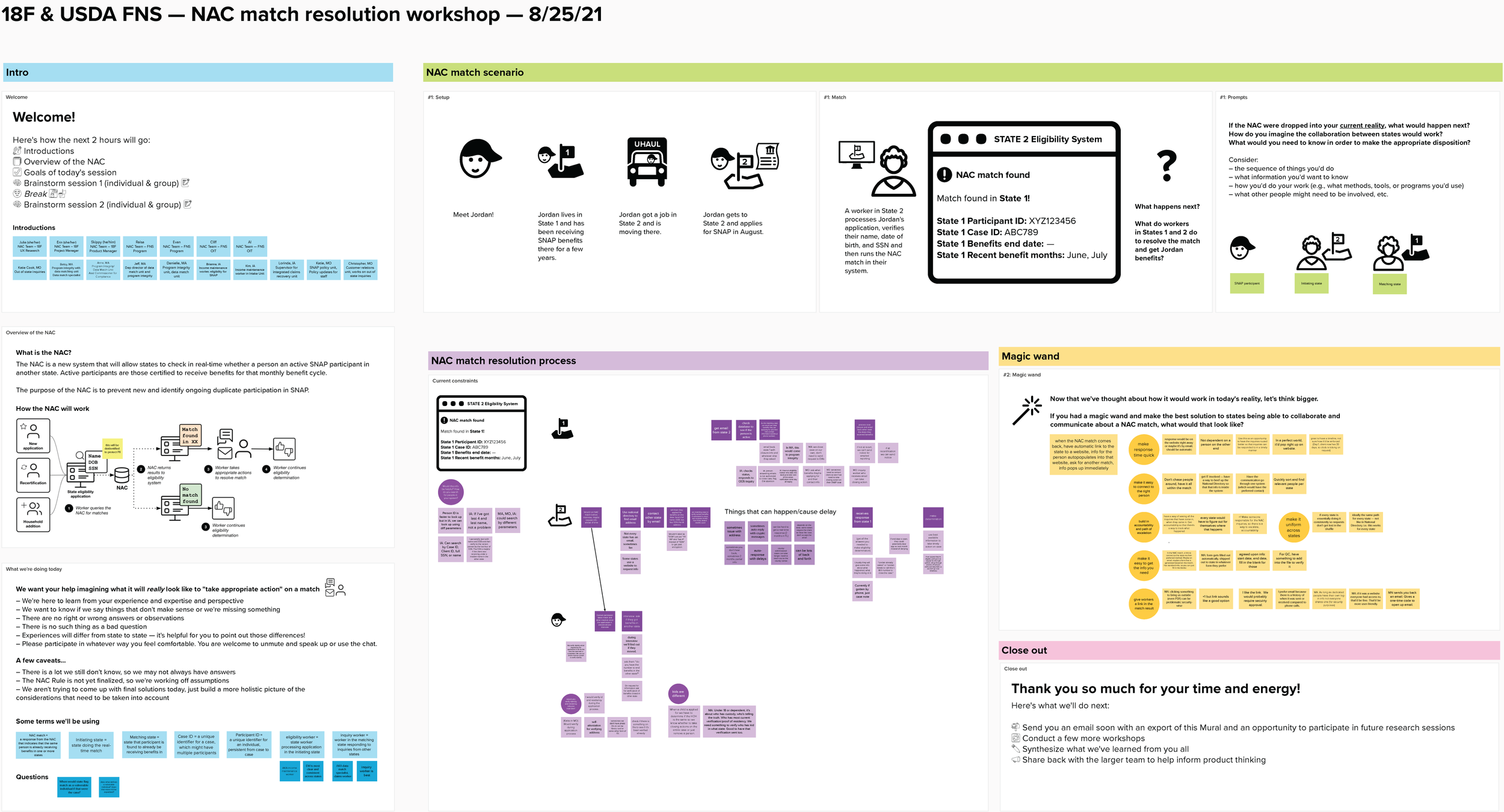
Mural board for the facilitation of participatory design workshops
Design
Creating visuals to drive stakeholder alignment
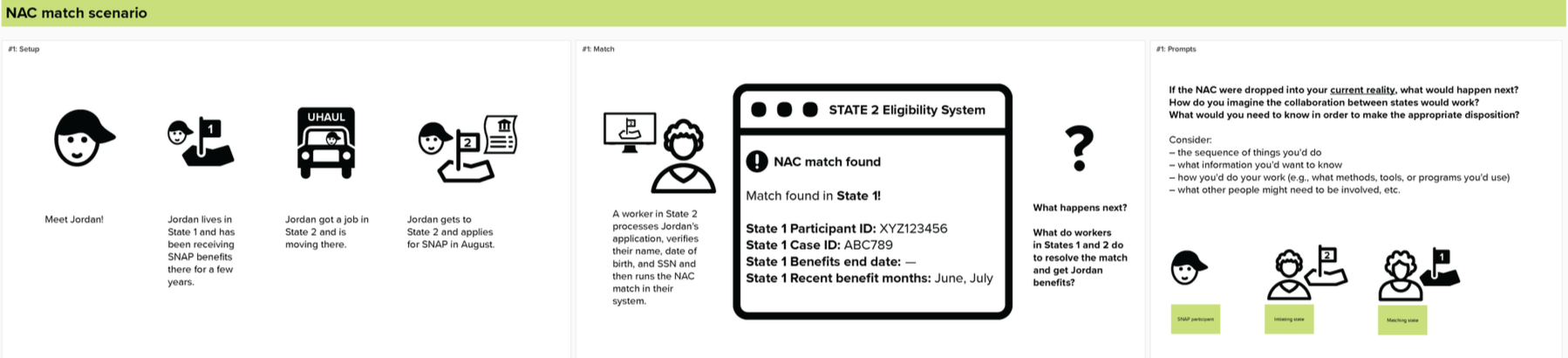
I mapped the existing SNAP application workflow to clarify exactly where and how the NAC would intervene, then storyboarded the new workflow for internal alignment, state collaboration, and development handoff. I also created a diagram explaining the system's privacy-preserving hashing architecture — designed to get executive and state buy-in on a technically novel approach to protecting PII.
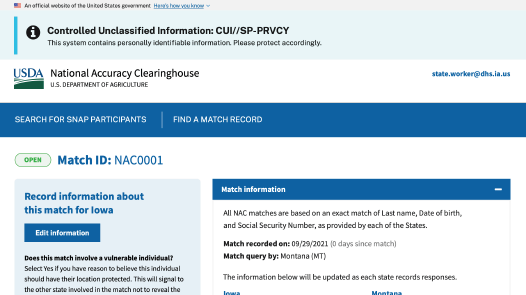
For the UI, I designed both a state worker-facing application and an FNS admin view, using USWDS with FNS branding. Iterating rapidly with pilot partners, the designs helped surface and resolve ambiguities in the match resolution process while the federal rule governing it was still being written — effectively using design as a tool to drive policy alignment.
SNAP worker view of a match record
FNS administrative view of a match record
Iterations of the NAC UI
I designed flows that would alert state workers when a match involved a vulnerable individual so that their address would not be disclosed in communications regarding the match.
Pilot partner recruitment
Rather than waiting for mandated adoption, we needed states willing to help shape the system early. I co-developed an evaluation rubric to identify states that were geographically diverse, technologically representative, and positioned to move quickly — prioritizing teams with tight program-to-dev relationships working in an agile way.
Ten states expressed interest; I facilitated structured evaluation conversations with each, ranked their readiness, and proposed an initial cohort of three. To preserve momentum with the remaining interested states, I worked with FNS to design a multi-tier pilot structure that kept everyone engaged.
Vendor transition
As the project matured, I contributed to the RFP by defining research and design criteria in the Quality Assurance and Surveillance Plan. I evaluated vendor proposals on UX competency and onboarded the selected vendor through workshops, document sharing, and side-by-side work — transitioning my responsibilities to a three-person team covering project management, research, and design.
Skills demonstrated
Foundational user research: Semi-structured interviews and contextual observation
Cross-functional leadership: coordinating research, design, pilot recruitment, and vendor handoff simultaneously across a complex multi-stakeholder program
Systems visualization: Workflow mapping, storyboarding, and architecture diagrams to align stakeholders on technically complex, policy-adjacent decisions
Participatory design: Co-design workshops with frontline workers to integrate a new system into existing workflows, surface edge cases, and build buy-in
Design as policy tool: Using iterative UI design to surface and resolve ambiguities in match resolution rules while the governing federal rule was still being written
UI & interaction design: USWDS-based design with agency branding for two distinct user types (state worker and FNS admin views); rapid iteration with pilot partners
Vendor transition management: Defining research and design criteria in RFP; onboarding selected vendor through workshops and side-by-side work
See more case studies from 18F
Vote.gov: Supporting the launch and evaluating the impact of a new vote.gov during the 2024 election cycle
The U.S. Data Federation: Building shared infrastructure for federated data and securing the longevity of a 10x effort through resources.data.gov